Showing posts with label Hail Caesar. Show all posts

Wednesday, May 5, 2021

A quick Celtic update


I've had unfortunately little time to paint anything recently, and subsequently have also been a bit quiet on the blog-front. However, I found some time this Bank Holiday Weekend to finish off some more Celtic reinforcements in the form of some light infantry javelin troops. I think these are Heroics and Ros figures - there's a slight scale difference with the more heroic-scale Baccus figures, and so I don't think I could get away with mixing them on the same base, but they work absolutely fine in their own units.


And with these bases finished, this brings me to the end of a full division! Hopefully I'll find time to take some shots of the full complement of bases this week.

Until next time!

Tuesday, March 16, 2021

Celtic chariots

I managed to find some time recently, to clear another unit for my rapidly growing Celts off of the painting table. This time, it's the dreaded light chariots! Once again, these are the beautiful Baccus sculpts, perhaps the finest Celtic models out there. 


Regular readers may know that I had initially intended for all of these Celts to be an allied division for a planned Carthaginian project. Unfortunately, in-game, chariots can only be used as part of a dedicated Celtic or British army list. However, this isn't a problem for me (if nothing else, at this rate, the Celts will soon be numerous enough to be an army of their own...) For the myriad armies where Celts appear as allies, I will instead use the chariots as 'counts as' light cavalry.  


As there are only four models to a unit, I thought I'd dedicate a little more time on each individual chariott. I'm really enjoying the bright vibrancy of these Celts, but this time I was also able to play with different horse colours and markings. I think my favourite is the brown and white pinto, as I really didn't think that it would translate well to a 6mm model, but the chestnut horses are also quite nice. Note also that each chariot has its own 'markings' on the frame - probably not accurate by any means, but I'm enjoying any opportunity to splash more bright colours on these models!


That leaves me with almost a full division - just some light units with javelins to go, as a screen for the heavier infantry units, and we're there! At this point I could stop, but something tells me I won't...

Anyway, until next time!

Thursday, March 4, 2021

Some Celtic reinforcements

The newest additions to the Celtic division / army are two units of warriors. The Baccus sculpts are absolutely beautiful figures (this goes without saying) and always a joy to paint, and I'm really enjoying the riot of colour that is a Celtic army in comparison to the Sumerians I've been painting. Again, as with the horsemen a few weeks ago, I've stuck to a colour trio of red, blue and green to try and tie the troops together a little bit:


I love that archetypal image of a mass of Celtic warriors charging towards the Roman lines. In order to recreate that, the units are a mixture of ranked warriors on the rear half of each base (in three rows to give a real sense of depth and numbers), and then a scattered number of the individual charging figures in front of these, to represent the front files breaking free and beginning to charge head-long towards the enemy. I think it works quite well!


This image is just to give a close-up of the shields. I think the slightly schematic dot-and-line approach I've gone for gives a quite good approximation of Celtic shield designs, whilst actually being paintable at 6mm scale!

As always, I hope you enjoy - until next time!

Sunday, February 28, 2021

The first finished division

 I thought I'd end the month with another quick update - a shot of the first completed Sumerian city-state division. Five units - two pikemen blocks, two small archer units and one of chariots - with an accompanying commander. Next will be to finish the tribal reinforcements, and then add a whole host of elamites, and then some more pikemen, and then-...


Until next time!


Sumerian reinforcements

 Another quick update today - the start of a second, tribal division for the Sumerian army. The first block is a small unit of Amorites, and a commander. I managed to rattle all of these out pretty quickly in one painting session - one of the many joys of 6mm miniatures!

I went for a bit of colour on these figures, more for visual interest than historical accuracy, as otherwise a early Sumerian army has a risk of being a bit 'fifty shades of beige'. I added strips of red and blue along the edges of garments. The commander stand echoes this, with striped cloth, representing their comparative wealth. I'm really proud of these figures; they pushed the limits of my abilities with 6mm, but they couldn't have come out better.


There actually aren't any companies providing 6mm Amorites, so I had to improvise somewhat. The figures are actually Irregular immortals from their Achaemenid range. Unfortunately they come with a quiver on their back, but other than that I think they're pretty good stand-ins. Plus, if I ever decide to start a Persian army, I'm already one unit down...


The rest of this division should be quite quick to finish up, with some stands of Gutian tribal warriors and some skirmishers; hopefully I'll be able to showcase these soon. Until next time"

Tuesday, February 16, 2021

The pitter patter of tiny hooves

 Just a brief update today, and the start of a second 6mm project. I've amasssed a lot of Baccus and Heroics and Ros Celts, which I intended to use a part of a larger Punic Wars project I've been toying with. The joy of Celtic units is their versatility; they might be allied divisions for either a Carthaginian or Republican Roman army, or alternatively (as is inevitably the case) the core of an army in their own right...

To test the scheme, I decided to quickly paint up a Command stand and unit of cavalry. I'm really happy with how these turned out; I think the shield designs I tried scale quite nicely to 6mm size, and are still 'legible' without making the shields too cluttered. 


And here are some close ups of the commander. I'm really enjoying these figures; a core colour scheme of red, blue and green alternated across figures hits a nice balance between individuality, and the riot of colour that would have been such an army, but also some sense of cohesiveness. 


As always, let me know what you think. Until next time!


Tuesday, January 12, 2021

Let slip the oxen of war!


A unit of Sumerian chariots, ready to trample the enemy...

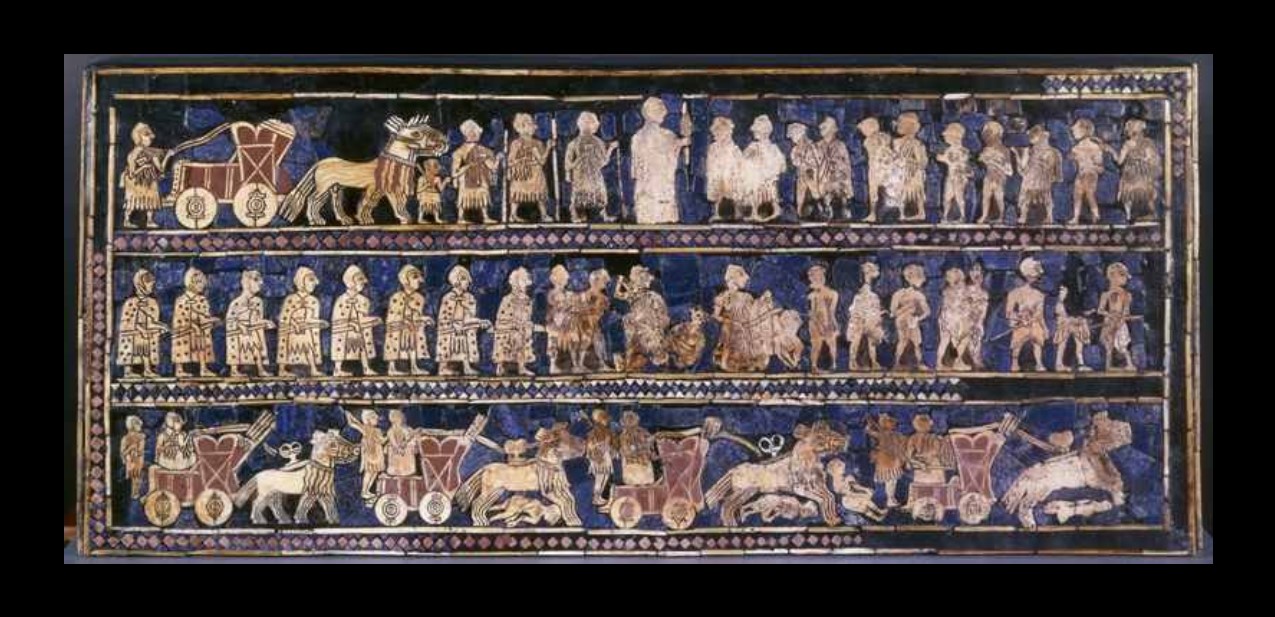
Today’s post is chariot-centric. Perhaps the most distinctive part of a Sumerian army, these ox-drawn ‘war wagons’ represented the pinnacle of 4th Millennium military equipment, and one of the first attempts at shock-and-awe tactics in warfare. No self-respecting commander could possibly be seen without one. The best representation of Sumerian chariots comes from the Royal Standard of Ur:


Chariots on the Royal Standard of Ur. Like in Egyptian art, the artist has attempted to represent the complete object and so the chariot is shown in a mixture of profile and front-on view; what seems like a double-curved side panel would actually have been the front of the chariot. The rein rings are likewise shown sideways to demonstrate their shape.

(c) British Museum


Other chariot depictions show a two-wheeled version. It is sometimes said that these were used for reconnaissance, but there is no primary evidence to support that:


There is some disagreement that chariots were actually used in battle, rather being used to convey commanders and nobles onto the battlefield, where they would fight on foot. However, the Standard of Ur refutes this somewhat, as do contemporary accounts – one text tells of Ur-Luma of Umma having to abandon 60 chariots during his retreat following a loss to the army of Lagash, and so they were clearly used in quite some numbers.

So, what better way to round off my first Sumerian division than a big block of chariots?


As with many aspects of Sumerian military equipment, the exact materials used to make chariots are unclear, as none have survived - itself an indicator of the materials used. Interpretations vary between a wooden frame and leather panels to a more lightweight reed and wicker construction, these being far more plentiful than trees in the marshes of Southern Mesopotamia. I’ve plumped for a contrasting dark and light brown scheme, more for the visuals than anything else, but I guess it could be interpreted as either set of materials (thus staving off potential controversy!). 


Accompanying this final unit to round off the division is a commander, perhaps Ur-Luma, Entemena or one of the other Sumerian kings. Although the same figure as for the chariot troops, I went for a slightly more elaborate scheme here, with red and blue barding rather than the red-and-white of the main unit, a simple way to show off the additional wealth that having textiles dyed in two colours would require.


The irregular chariots are an absolute joy to paint, and are packed full of detail. There will definitely be more of these to come...

Until next time!


Tuesday, December 22, 2020

Supplementary Sumerian Spearmen

 Just a quick update before Christmas, as I managed to get another unit of Sumerian spearmen off of the painting table, leaving me with almost a full first division:


Lurking at the back is the commander. There'll be a proper post on him, and the final unit of this division - the iconic Sumerian chariots - in the New Year. Until then, I hope everyone stays safe and well, and let's hope 2021 brings more joy than the last year...


Thursday, December 10, 2020

6mm Sumerians - the project begins

Today’s blog post takes us straight into the world of 6mm. I’ve wanted to paint some Hail Caesar armies in 6mm for a long time—the sheer visual appearance of massed armies at this scale just can’t be beat, and the amazing work by IrregularWars and other 6mm-dedicated blogs has been a constant source of inspiration. Overwhelmed with possibility—Romans? Carthaginians? Egyptians?—I decided to let history be my guide, and start at the very beginning, with the Sumerians. 

Located in what is now Southern Iraq, Sumer has often been claimed as the origin of civilisation. Among the first to develop writing and urbanisation, the Sumerians fascinate me, especially their language - an isolate whose linguistic affiliations still cause disagreement. In fact, much about the origins of the Sumerians is still debated; no wonder fringe theorists still turn to early Mesopotamia for evidence of ancient aliens! The Sumerians also provide quite an easy ‘in’ to 6mm wargaming, as by their very nature such early armies are both smaller, but also quite limited in scope.

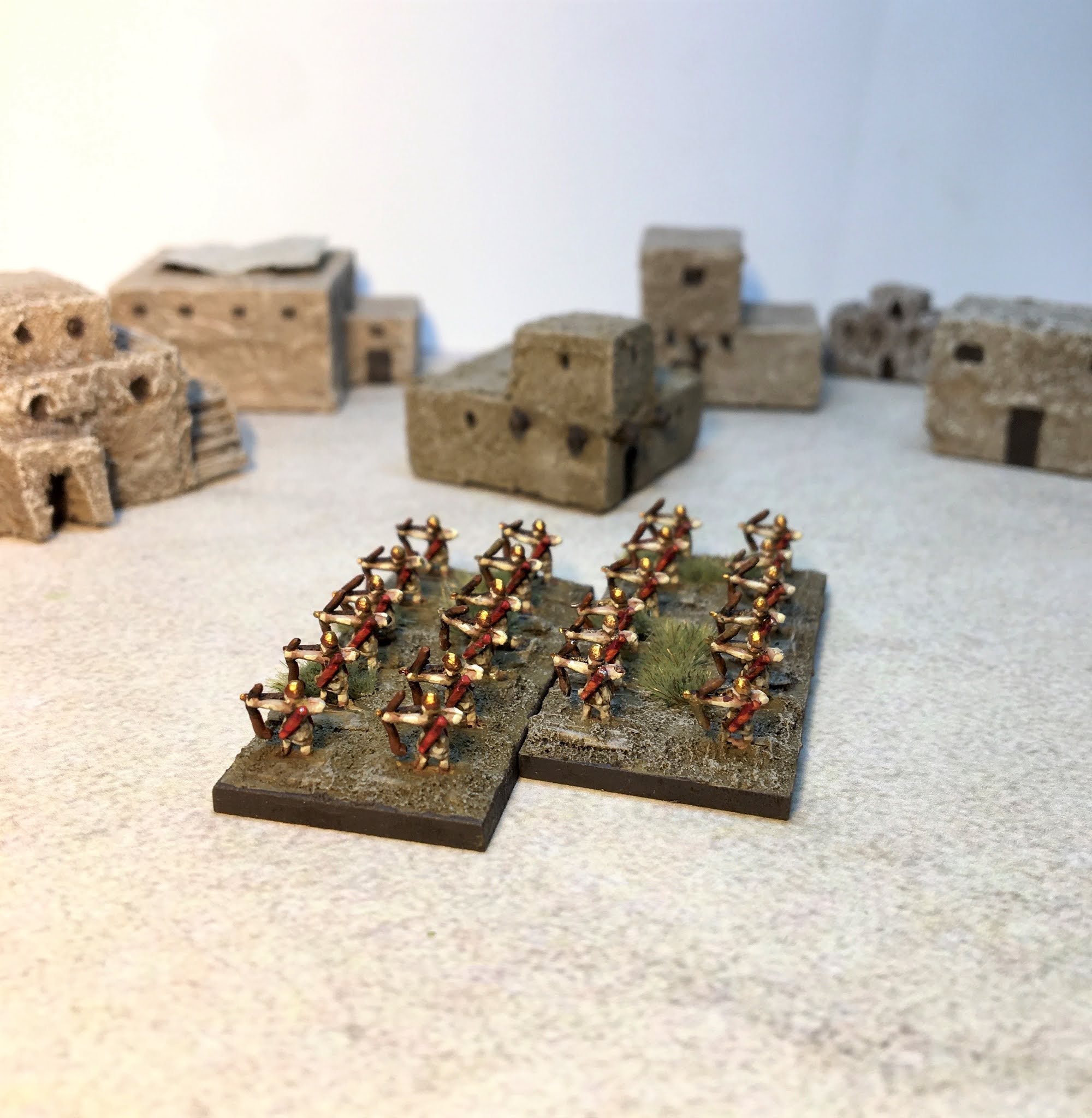
Whenever I begin a new project, I like to start with a quick unit both to get my eye in, but also to see how the colours will work at that scale. This is especially important at 6mm, as at this size it’s about contrast and ‘legibility’ from a distance; there’s no time (or physical space on the model!) for endless meticulous detail. So, first off block is a unit of archers:


And here they are next to their bigger 28mm brothers, for scale:


Although several companies make 6mm Sumerians, it seems that none make archers, despite their being fundamental to armies of the period. Fortunately, at 6mm scale things are quite forgiving and it becomes easier to substitute in other figures that look ‘right’ from a distance. These are Heroics and Ros archers, from their Etruscan light infantry pack; painted with copper helmets and sheepskin kilts, they look just the job.


Of course, no Sumerian army is complete without massed ranks of spearmen, so this unit was next off the block. These are from Irregular’s beautiful 6mm Sumerian range:


There’s some discussion when it comes to Sumerian military equipment. Surviving depictions such as the ‘Standard of Ur’ and the ‘Vulture Stela’ (below) show warriors in helmets, kilts, and long, studded cloaks. Finds from city of Ur suggest that the helmets were copper with a leather cap below, and modern depictions conventionally interpret the kilt as sheepskin, and the cloak as copper-studded leather. However, some instead see the cloak as felt or cloth. To avoid potential controversy, I’ve decided to plump for the ‘traditional’ depiction of Sumerians—copper helmets, dark red leather cloaks and felt kilts. If nothing else, I like the visual contrast of these three core colours. Whether the long shields of spearmen were wicker or leather is also uncertain; the colour I’ve chosen could handily be interpreted as either…


Depictions like the Vulture stela show massed, phalanx-style ranks. It has been proposed that, since the Sumerian number system was both decimal and sexagesimal, formations were based on this principle, with a basic ‘unit’ comprising 60 soldiers. Certainly, the Vulture stela seems to show a column 10 by 6! Since the Irregular spearmen are in ranks of 6, this works quite nicely.


Sumerian warriors as depicted on the Vulture Stele (c.2500-2340 BC). This stela records perhaps 
the earliest detailed war account, between the city-states of Lagash and Umma (Lagash won).
 © Louvre Museum


So, the army begins! What's next, I hear you cry? Well, more spearmen, obviously, but also a commander to lead this first fledgling division...


Tuesday, December 1, 2020

Hello and welcome!

It’s difficult to know how to open a blog; perhaps I should begin by saying a little about myself. I’m Ben, a museum curator by day and miniature painter by night, and this blog is devoted to chronicling my journey through historical wargaming.

I’ve been a hobbyist for as long as I can recall; one of my earliest hobby memories is inheriting my dad’s collection of figurines from the 1980s.* I began, as so many people did, with Warhammer, but over time I was increasingly drawn to the historical side of the hobby. In hindsight, this is totally unsurprising; history was always my passion, and as an Egyptologist and museum curator I now get to pursue that passion every day in the workplace. Really, my hobbying is an extension of that.

In recent years, I found myself with less time to hobby, as real-life commitments increasingly became a priority. However, over the last year or so, I’ve managed to carve out time to properly re-focus. This last year also saw a marked shift in how I hobby. I used to paint alone, never really playing any of the games or sharing my work with a community. This time, I vowed to be different. I started an Instagram account, and the feedback there has been incredible, really spurring me on to keep painting and posting updates once or twice weekly.** Most of my engagement there revolves around the Lord of the Rings game, and whilst I will still keep that up I felt it was time to start up a blog devoted solely to my historical models, to give them some of the spotlight.

So, what can you expect from this blog? Well, as you’ll have guessed from the above spiel, it’s all about history, baby. I paint mainly in 6mm (ancients) and 10mm (medieval) scales, but dabble with 28mm for skirmish games like Saga. I’ll be posting once or twice a week to show off works in progress or finished pieces, and there’ll be plenty of tutorials. This will also be a forum for me to combine my paintings with musings on history, so expect plenty of pedantic commentary about fabric patterns and shield shapes.

 Anyway, you’re here to look at things, not to read my ramblings, so here's something to whet the whistle. Thanks so much for stopping by – until next time!


*Some subsequently received the obligatory terrible thick coat of paint, a rite of passage for all 10 year olds picking up a paintbrush for the first time, but others still lie pristine in their boxes. That Citadel Great Spined dragon is probably worth more than my flat now…

**For those of a fantasy bent do please check out my Instagram page (@model_man_ben). Several of my historical miniatures have already been posted there.


A quick Celtic update

I've had unfortunately little time to paint anything recently, and subsequently have also been a bit quiet on the blog-front. However, I...